Page 2 of 2

Re: Gun Cleaning/Care question

Posted: Fri Jul 29, 2011 9:27 am
by jason237m
Excaliber wrote:
jason237m wrote:The gun is more likely to jam from putting it back together wrong than due to residue after just 100-200 rounds.

Just play the percentages.
It works even better if you field strip it, clean it, lubricate it, and put it back together right - as close to 100% as you can get.

Anything less is unacceptable for life safety equipment.

If you do that every time you shoot, you get pretty good at it and improper reassembly isn't an issue.

If you do that so infrequently that improper reassembly is an issue, some refresher training would be a better idea than hoping for proper functioning from a dirty unlubed gun.

Hope isn't a plan.
I respectfully disagree. I shoot many thousands of rounds a year at matches and in practice. After several years of doing it, expeirence has taught me that 100-200 rounds is nothing for a well tuned gun shooting quality ammo. If I was betting my life I would prefer a gun I had cleaned, put some rounds through to ensure function and then put away as compared to a gun I cleaned, assembled and put away. As you said hope is not a plan.

Re: Gun Cleaning/Care question

Posted: Fri Jul 29, 2011 10:45 am
by barres
I try to clean my guns after every range trip, but my wife hates the smell of Hoppe's, so that doesn't always happen. My reasoning isn't due to functioning questions, as I and others have all shot a gun that was dirty at one time or another with no undue issues. My reasoning is due to a story I heard either here or one of the other gun boards I frequent.

A man was pursued by an aggressive driver. He took several turns, detours, and double-backs, and he thought he had lost his tail, so he finally went home. As he was exiting the vehicle, here comes the aggressive driver, again. As he is being faced by a clearly irrational man wielding a several-thousand pound deadly weapon, he draws his legally carried pistol. Upon seeing this, the other person flees, with no shots fired. A very few minutes later, there is a knock on the man's door by the local police (there must have been a donut shop just around the corner ;-) ). The aggressive driver had called and said that the man had shot at him several times, giving a description and the address of the man. The man tells his side of the story, but, as has been said here many, many times, the first person to call the police is treated as the victim, until the evidence proves otherwise. The man surrenders his weapon to the officers, who inspect it. It is fully loaded, as are all the spare mags on the man's person, but he is at home, so he could have reloaded between the call being placed and the officers' arrival. The man field strips the pistol and shows the officers that it is scrupulously clean. Too clean for it to have been fired at the aggressive driver and there to have been enough time to get it that clean before the police arrived. The lack of GSR validated the man's story, and the police went on their way.
I know, if we're ever in a situation where we have to pull our handgun, we need to be on the phone with the police ASAP, if not sooner, but knowing that I could show that I hadn't fired a gun if unjustly accused of doing so sure makes me feel a bit better.

Of course none of this applies to "fun guns," such as my .22 plinker and any guns designated for competition, not carry. But in my case, any handgun but the .22 can and does get carried from time to time.

Re: Gun Cleaning/Care question

Posted: Fri Jul 29, 2011 10:55 am
by Excaliber
jason237m wrote:
Excaliber wrote:
jason237m wrote:The gun is more likely to jam from putting it back together wrong than due to residue after just 100-200 rounds.

Just play the percentages.
It works even better if you field strip it, clean it, lubricate it, and put it back together right - as close to 100% as you can get.

Anything less is unacceptable for life safety equipment.

If you do that every time you shoot, you get pretty good at it and improper reassembly isn't an issue.

If you do that so infrequently that improper reassembly is an issue, some refresher training would be a better idea than hoping for proper functioning from a dirty unlubed gun.

Hope isn't a plan.
I respectfully disagree. I shoot many thousands of rounds a year at matches and in practice. After several years of doing it, expeirence has taught me that 100-200 rounds is nothing for a well tuned gun shooting quality ammo. If I was betting my life I would prefer a gun I had cleaned, put some rounds through to ensure function and then put away as compared to a gun I cleaned, assembled and put away. As you said hope is not a plan.
While I would agree that 100 - 200 rounds through a well maintained high quality gun shouldn't create a significant risk of malfunction, more than that does gradually increase the risk in my experience and opinion.

The military has some experience in this area as well, and my practice is in line with theirs.

YMMV.

Re: Gun Cleaning/Care question

Posted: Fri Jul 29, 2011 10:57 am
by Skiprr
On the CLP front, a number of years ago I started preferring a combination of oil and gun grease for carry guns. With the combination of Texas summers and IWB body heat, light oil doesn’t stay where it’s placed over the course of days of carry. I like to use a purpose-made gun grease like Wilson’s UltimaLube II or Mil-Comm’s TW25B for barrel/bushing/slide and slide/frame contact points. These are light greases that are highly viscous at normal temperatures, and stay where they’re applied. They also have extreme temperature tolerances and tend to be less attractive to dirt, grit, and lint than are oils.

After I began using the TW25B grease almost exclusively, I also started buying the product in their aerosol lubricant/protectant form; I especially like it for my semi-auto rifles. It uses an isopropyl alcohol carrier that pretty much pushes moisture out of the way, with the result being a light coating of TW25B applied dryly and evenly. For handguns, I’ll field strip and clean, then lightly spray the internals in the frame, slide, barrel (inside and out), recoil spring, and other disassembled parts (e.g., bushing and slide stop for a 1911). I’ll give it a moment for the alcohol dispersant to evaporate, then apply some of the grease to the rails and exterior of the barrel, including the barrel hood.

Depending upon the gun, I may or may not also add a drop of gun oil to the barrel lug and hammer/striker area (or the disconnector on 1911s). For the oil, I also go with a Mil-Comm product, MC2500; or, if that’s not handy, Wilson’s UltimaLube II, or FP10. A tube of oil lasts a very long time at that pace.

Ain’t perfect, and some prefer a “wetter” gun. But it’s worked pretty well for me, and I end up with what I feel is a protected, well-lubricated gun that stays “dry” during daily carry and keeps the lubrication where it’s most needed.

Re: Gun Cleaning/Care question

Posted: Fri Jul 29, 2011 1:17 pm
by Excaliber
Skiprr wrote:On the CLP front, a number of years ago I started preferring a combination of oil and gun grease for carry guns. With the combination of Texas summers and IWB body heat, light oil doesn’t stay where it’s placed over the course of days of carry. I like to use a purpose-made gun grease like Wilson’s UltimaLube II or Mil-Comm’s TW25B for barrel/bushing/slide and slide/frame contact points. These are light greases that are highly viscous at normal temperatures, and stay where they’re applied. They also have extreme temperature tolerances and tend to be less attractive to dirt, grit, and lint than are oils.

After I began using the TW25B grease almost exclusively, I also started buying the product in their aerosol lubricant/protectant form; I especially like it for my semi-auto rifles. It uses an isopropyl alcohol carrier that pretty much pushes moisture out of the way, with the result being a light coating of TW25B applied dryly and evenly. For handguns, I’ll field strip and clean, then lightly spray the internals in the frame, slide, barrel (inside and out), recoil spring, and other disassembled parts (e.g., bushing and slide stop for a 1911). I’ll give it a moment for the alcohol dispersant to evaporate, then apply some of the grease to the rails and exterior of the barrel, including the barrel hood.

Depending upon the gun, I may or may not also add a drop of gun oil to the barrel lug and hammer/striker area (or the disconnector on 1911s). For the oil, I also go with a Mil-Comm product, MC2500; or, if that’s not handy, Wilson’s UltimaLube II, or FP10. A tube of oil lasts a very long time at that pace.

Ain’t perfect, and some prefer a “wetter” gun. But it’s worked pretty well for me, and I end up with what I feel is a protected, well-lubricated gun that stays “dry” during daily carry and keeps the lubrication where it’s most needed.
I use a grease (TW25B or similar) on the frame / slide rails and oil elsewhere.

Works for me!

Re: Gun Cleaning/Care question

Posted: Fri Jul 29, 2011 5:30 pm
by sugar land dave
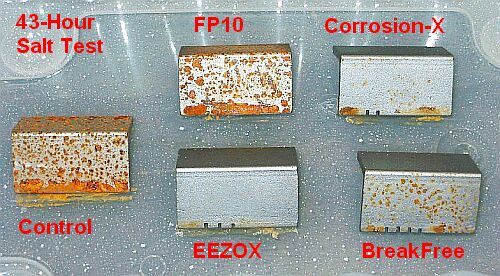
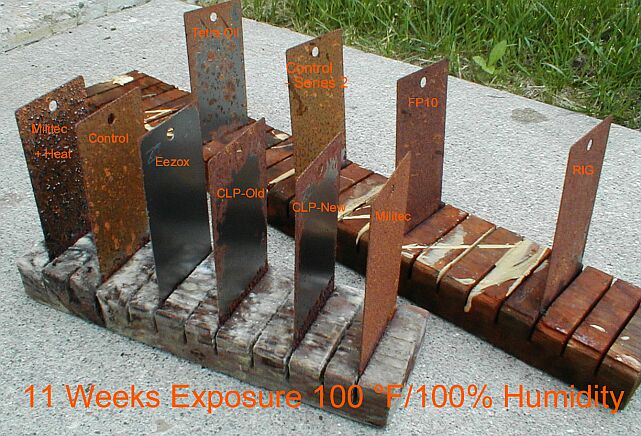
Several good ones have been mentioned. After researching, I chose Eezox.

http://www.6mmbr.com/corrosiontest.html

Image
Image

Re: Gun Cleaning/Care question

Posted: Fri Jul 29, 2011 7:58 pm
by snatchel
I clean everything buy Glocks after range days. Glocks get cleaned twice a year, reguardless of how many rounds are sent through it. I break it down into individual parts, clean all the metal parts with hops and clp, and throw the plastic frame into the dishwasher.. I kid you not.

Re: Gun Cleaning/Care question

Posted: Fri Jul 29, 2011 10:37 pm
by v-rog
Unfortunately, I can't go 11 weeks without shooting... "rlol" CLP is fine for me...
sugar land dave wrote:Several good ones have been mentioned. After researching, I chose Eezox.

http://www.6mmbr.com/corrosiontest.html

Image
Image

Re: Gun Cleaning/Care question

Posted: Fri Jul 29, 2011 11:11 pm
by Skiprr
sugar land dave wrote:Several good ones have been mentioned. After researching, I chose Eezox.
Just an observation that lubricity and corrosion/rust prevention aren’t the same thing. Nice to have a combination of both, but the function of a well-maintained firearm depends upon the ability of parts to move smoothly over other parts. If the firearm is corroded and rusted, it wasn’t maintained in the first place.

Re: Gun Cleaning/Care question

Posted: Sat Jul 30, 2011 10:52 am
by sugar land dave
Skiprr wrote:
sugar land dave wrote:Several good ones have been mentioned. After researching, I chose Eezox.
Just an observation that lubricity and corrosion/rust prevention aren’t the same thing. Nice to have a combination of both, but the function of a well-maintained firearm depends upon the ability of parts to move smoothly over other parts. If the firearm is corroded and rusted, it wasn’t maintained in the first place.
Thank you for your comment. I agree with you and each person will decide what factors make for the most pleasurable experience when maintaining their firearms. I would add that my research suggests that the dry lubricant within Eezox performed quite well in lubricity testing.

"Synthetic EEZOX Premium Gun Care with only 0.42 - 0.45 mil film thickness achieved a Peak Load "pass" of 4,500 lbs. This load factor far exceeds pressures found in any firearm, including full automatic machine guns. Falex tested by ASTM D-3233 procedures (Mil Spec requires only 1,000 lbs.)" http://eezox.com/gun-care.html

Specs of dry lubricants: http://www.advceramics.com/downloads/do ... /81506.pdf

ASTM D-3233 "Measurement of Extreme Pressure Properties of Fluid Lubricants (Falex Pin and Vee Block Methods)"

This test measures the load carrying ability of an oil. The tribological aspects are low speed, line contact, steel on steel (this can be altered), sliding motion. A 1/4 inch (6.35 mm) diameter test journal or pin is rotated at 290 rpm between two Vee Blocks immersed in the oil preheated to 120°F (51.7°C). Procedure A employs a constant increase in load applied by an automatic ratchet until failure as indicated by seizure of the test coupon or rapid loss of load caused by excessive wear. Procedure B employs load increments of 250 lbs with running for 1 minute at each increment until failure.
http://www.pltlab.com/desc.html